Robert Kipniss

Robert Kipniss, painter and printmaker, was born in New York City in 1931. Kipniss studied at the Art Students League in 1947, Wittenberg University in Springfield, Ohio, 1948-50, and the University of Iowa, receiving a BA degree in English literature in 1952, and an MFA in painting and art history in 1954.

Kipniss began his career as a painter, enjoying his initial New York solo exhibition in 1951. He produced his first print in 1967 at the urging of Murray Roth, his dealer at the time. After first producing etchings and drypoints from copper plates, Kipniss switched to lithography and began a two decade collaboration with the master printer Burr Miller. Following this period, Kipniss turned his efforts to mezzotints.

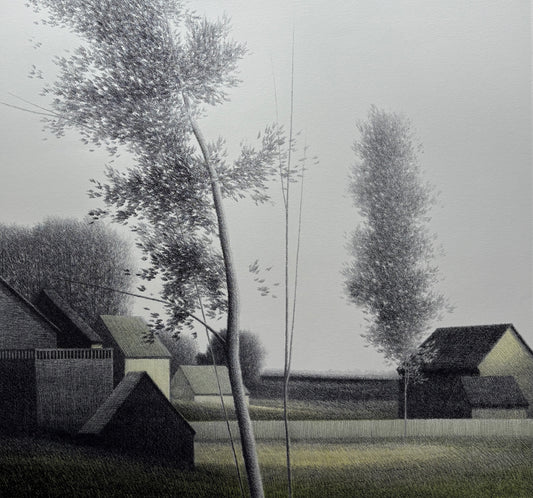
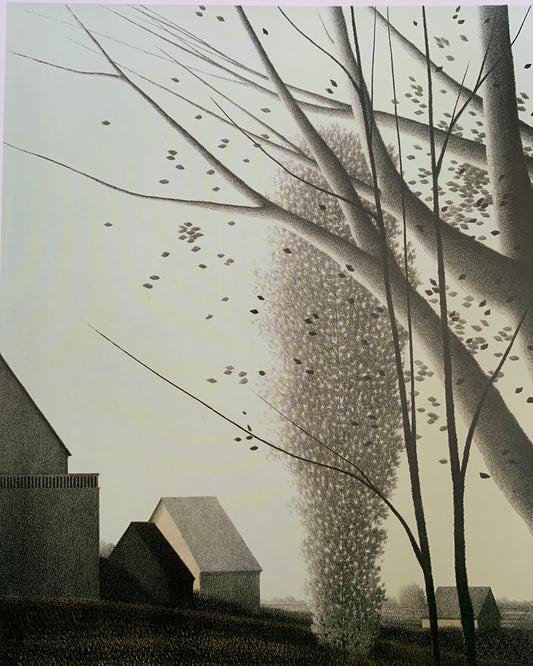
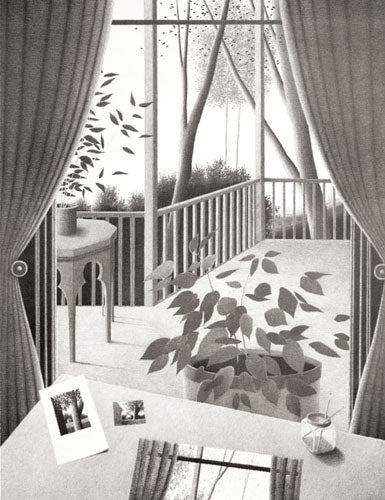
The artist employs a meticulous technique combining a multiplicity of specific strokes, whether with brush, pencil or print-maker’s needle and burin, to create the essence of his essentially monochromatic, stylized vistas with natural and architectural elements. The artist has eloquently stated that the “central impetus of my work is the endless range of feelings and thoughts evoked by the basic act of seeing, usually in isolation, and with a haunting intensity.”

In his career, Robert Kipniss has had over 200 One-man Shows since the first in New York in 1951. Recent Group Shows include; the Royal Academy, London, Royal Academy Summer Show, 2001, The British Museum, London, Recent Acquisitions, 2000 and the National Academy of Design, New York, Treasures Revealed: Nineteenth- and Twentieth-Century American Works on Paper, 1999. An exhibition of his work, Seen in Solitude: Robert Kipniss Prints from the James F. White Collection, was selected to reopen the New Orleans Museum of Art in 2006.

Robert Kipniss is represented in numerous public collections in the United States, South America and Europe including: The Art Institute of Chicago, The Metropolitan Museum of Art, the Whitney Museum of American Art, the Library of Congress, The British Museum, London, the National Academy of Design, New York, Bibliothèque Nationale de France, Paris, the Royal Society of Painter-Printmakers, London (diploma piece), the Los Angeles County Museum of Art, Los Angeles, The Museum of Fine Arts, Boston and The Morgan Library and Museum, New York, NY.

He was elected to the National Academy of Design in 1980, and to the Royal Society of Painter-Printmakers, London in 1998. In 2008, he received a Lifetime Achievement Award from the Society of American Graphic Artists. He has also received the Speicher-Hassam Purchase Award from the American Academy of Arts & Letters, the Benjamin West Clinedinst Medal from the Artist’s Fellowship as well as Honorary Doctorates from Wittenberg University and Illinois College.

Robert Kipniss can be referenced in numerous publications, including Who’s Who in American Art from the 1950s to the present, and multiple reviews in periodicals like Art News, Art in America and Art Forum. There are also three important Catalogues Raisonné published on his work..

Mezzotints

Lithographs

Dry Points

First Impressions

Drawings

Publications

Mezzotints

Lithographs

Dry Points

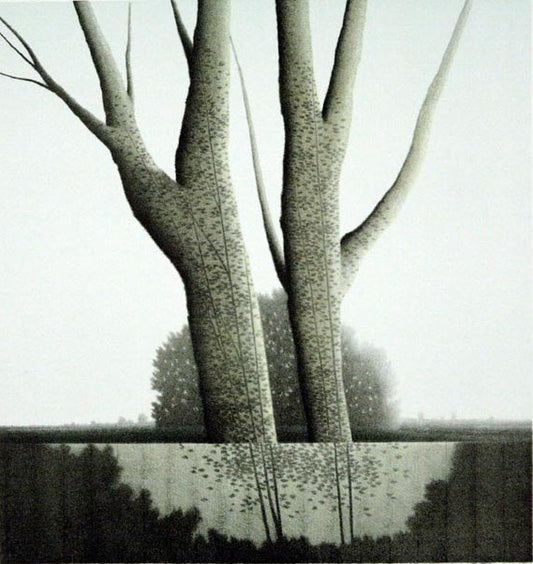
“With “Pages from a sketchbook,” Kipniss defined the negative space between tree trunks and gave the works the quality of sketches made on site.” Trudie A. Grace, “Robert Kipniss Intaglios 1982 – 2004”. Printed from two plates: the first a steel faced copper plate containing the image and the second, an unfaced copper plate to apply tone.

First Impressions

Drawings

Publications

“Robert Kipniss Intaglios 1982 – 2004”

Intro and documentation by Trudie A. Grace, essay by Thomas Piche Jr.

Published by Hudson Hills Press, New York, 2004.

183 pages, 156 color illustrations.

Hardback, 9 x 12 in.

Price: $60, Signed: $99

“To begin to see like Kipniss, one must be prepared to elide congested tangles of branches, renounce decorative architechtural details, and simplify overly fussy groupings of objects.” Thomas Piché jr.

Robert Kipniss has been widely known for several decades as a painter and printmaker producing works evocative of intense contemplation and rendered with extraordinary technical facility. Part of Kipniss’s reputation lies in his frequent use of the mezzotint technique in a highly personal manner that involves showing the action of the hand in the intimate act of drawing. While his choices of subject matter-landscapes, views of houses, and still lifes-link him to representational art, Kipniss’s distillation of forms produces formal interactions that often verge on the abstract.

Robert Kipniss: Intaglios 1982-2004 reproduces 139 intaglio prints including mezzotints, drypoints, roulette prints, and etchings. Hand colored mezzotints, drawings, and paintings are also illustrated. Kipniss’s intaglios are found in many of the foremost public and private collections in the United States and Europe.

Thomas Piché, Jr., is former senior curator at the Everson Museum of Art, Syracuse, New York. Dr. Trudie A. Grace, former associate curator of the National Academy of Design, New York City, is curator of the Putnam County Historical Society & Foundry School Museum, Cold Spring, New York and lectures on art history at the Fashion Institute of Technology, New York.

“Robert Kipniss: Intaglios 1982-2004; Deluxe Edition”

Intro and documentation by Trudie A. Grace, essay by Thomas Piche Jr.

Published by Hudson Hills Press, New York, 2004.

183 pages, 156 color illustrations in cloth slipcase with embossed title in both the slipcase and binding.

Hardbound deluxe edition with two artist signed prints; Interior w/mountain, 2004 and Nocturne w/six trees, 2004, created specifically for this edition.

Deluxe edition size: 150 + 25 artist proofs.

Signed and numbered xiv/xxv.

Condition: Excellent

Price: On Request

“Robert Kipniss Paintings 1950 – 2005”

Forward by: E. John Bullard, essay by Richard J. Boyle.

Published by Hudson Hills Press, New York, 2007.

148 pages, 102 color illustrations.

Hardback, 9 x 12 in.

Price: $60, Signed: $99

This stunning monograph of the paintings of Robert Kipniss is the culmination of nearly forty years work. His paintings, like his print work, are evocative of intense contemplation and rendered with extraordinary techincal facility. While Kipniss’s choice of subject matter varies from landscape to still life to a mixture of structures and natural forms they all share a sense of mystery, grace and quiet solitude. Although linked to representational art, Kipniss’s paintings produce formal interactions that often verge on the abstract. His work can be found in major collections in the United States and Europe.

Robert Kipniss: Paintings 1950 – 2005; Deluxe Edition

Foreword by: E. John Bullard, essay by Richard J. Boyle.  Published by Hudson Hills Press, New York, 2007.  148 pages, 102 color illustrations, cloth cover in slipcase with embossed title in both the slip case and binding.  Deluxe edition with one artist signed print; Silver Morning, 2007, created specifically for this edition.  Deluxe edition size: 300 signed and numbered copies + 25 artist proofs.  Signed and numbered xxii/xxv.

Condition: Excellent.  Price: $1,500

Silver Morning, 2007

Silver morning, Mezzotint, 2007. 6 3/8 x 4 1/2 in.


“Robert Kipniss – A Working Artist’s Life”

by Robert Kipniss

Price:  $40, autographed. Shipping fee: $7.95.

According to Mr. Kipniss:

“The purpose of this book is to tell the story of how one artist established himself, a narrative in which incidents affecting the life, the work, and the career are intertwining threads often indistinguishable from one another.

Poetry and painting were equal passions of mine until I turned thirty and became a father, and I had to earn more money. Getting an evening job meant making a choice, and I stayed with painting, shelving my writing as something I would return to later, perhaps when I was much older. About thirty years ago, I thought of my past as having been episodic as I reflected on many experiences and personalities that seemed singular, each in some way shaping my development. Quite aware of how significant these events had been throughout my youth and later as a young adult, I began writing down those memories, even though I wasn’t sure what I would do with the scattered observations of incidents and thoughts. When I was fifty-two, I decided to gather them together, and I wrote twenty-eight chapters of something I thought might eventually become a memoir. I regularly wrote and revised the manuscript, laboriously typing and retyping every word. It was a time-consuming and discouraging effort, and I ended up putting the pages aside.

When my paintings began to find an audience in galleries around this country and abroad, dealers began publishing catalogues about my work. It was a catalyst to begin writing essays about working as an artist as well as about the art itself. It felt good to be writing again and seeing my thoughts in print. Then a few years ago I bought a computer, which made rewriting much easier, and soon I took up the memoir again, purposely avoiding looking at the earlier material until the new manuscript was nearly finished. I was concerned that the rougher quality of my earlier writing might dishearten me, and when I finally did read those chapters again, I found, to my surprise, That I had forgotten virtually nothing.

In this memoir, as I explored my memories, more memories came forth. There was much clarity and detail, even of conversations, but not always of dates, and for that I needed to do some research. I had always been careful about keeping a record of my exhibitions, although not of my individual paintings, and this was helpful because I could easily place events in the context of what paintings I remembered doing at certain times, and where they had been exhibited. Sometimes I remembered too many details and too many stories, which interrupted the narrative, and these I left out. There was also much help from the research department at the Whitney Museum of American Art.

While working on this book, I continued painting in my studio in Westchester County during the week. I wrote on weekends at my home in northwestern Connecticut instead of burnishing copper plates, essentially giving up printmaking for nearly three years.

It has been illuminating to revisit the various periods of my past. As my life was happening, it was impossible to know how each day was shaping its tomorrow, or the following month, or the next year. When I neared the conclusion of this book and reread what I had written, I was startled and pleased to see that instead of a random collection of episodes, I saw my life emerging as a whole. I found a consistency and coherence that was as much a function of personality, instinct, and my compulsion to create as it was of conscious thought. It was a perspective impossible to have until I had lived almost eighty years.

Writing about my life has been a little like reliving it, but with the advantage of seeing the unfolding problems and troubles in the context of their eventual resolution. I found this second visit a good thing, even with its many uncomfortable moments, and it has left me at peace, my enthusiasm undiminished.“


Robert Kipniss A Suite of Ten Lithographs cover 1

Robert Kipniss A Suite of Ten Lithographs cover 2

A Suite of Ten Lithographs drawn by Robert Kipniss for the Selected Poems of Rainer Maria Rilke

In 1981, Robert Kipniss was asked to illustrate a bi-lingual publication of the Selected Poems of Rainer Maria Rilke by C.F. MacIntyre. The result was the beautiful suite of ten black and white lithographic prints, bound into the limited edition of 2000 copies, published by The Limited Editions Club. The effect is described by Dr. Karl Lunde in his book, Kipniss: The Graphic Works; i.e. “In these lithographs the artist makes tangible the elegiac poetry of the piercing beauty of landscape when experienced alone, and holds it in poignant solitude for our contemplation…Kipniss’s prints represent the emergence of purity and wonder. These poetic landscapes and objects are “dreams which lead us to discover the special unity of man and nature.”

“In the artistry of Robert Kipniss and Rainer Maria Rilke, man’s relation to the universal is a vital concern, though one expresses himself in the written work and the other in a graphic medium that has no language but the universal. The ten lithographs that Kipniss has made for the Selected Poems of Rilke evolve from years of communion by the artist with Rilke’s poetry – specifically with his favorite translations, the MacIntyre versions.” [1]

A rarely available, limited publication of boxed sets of “A Suite of Ten Lithographs drawn by Robert Kipniss for the Selected Poems of Rainer Maria Rilke”, printed in color, published concurrently with the limited edition of the Selected Poems of Rainer Maria Rilke. These colored suites, published in 1981, inscribed and signed by the artist and boxed along with the associated poems by Rilke in an edition of 120 with 15 artist’s proofs and 10 H.C.’s. Offered separately or in combination with a signed copy of the Selected Poems of Rainer Maria Rilke.

[1] The Monthly Letter of The Limited Editions Club, January 1981, Number 518.

Illustrations

The Poems

Robert Kipiss is represented in depth at ebo Gallery.  Please contact the Gallery to inquire about additional works.

Contact us to inquire about purchasing artworks; please include the title and artist's name.